
Factory Relocation: We Relocated the Factory. But Did We Transfer the Capability?
We are living in a period of constant economic and business change. Companies face increasing pressure to remain competitive, control costs, improve efficiency and adapt to new market conditions. As a result, decisions that would once have taken years to consider sometimes need to be made much faster.
Restructuring operations, relocating production, transferring activities between countries, reducing costs or changing business models are part of the reality of running a business today. From a business perspective, many of these decisions make perfect sense. The financial calculations are done, the expected benefits are identified, the risks are evaluated and the strategic direction is established.
And sometimes these decisions are not only reasonable; they are necessary. Businesses cannot ignore rising costs, changing markets or competitive pressure. Leadership has a responsibility to ensure that the business remains viable and sustainable in the long term, even when difficult choices are required. But there is something that can look very different when a decision moves from a presentation in a management meeting into the reality of daily operations.
A decision may be made in one country, in a management office, based on financial projections, strategic objectives and expected efficiencies. Its implementation, however, may depend on people working thousands of kilometers away, who are expected to transfer knowledge, establish processes, train new teams and deliver the promised results.
And this is where things can become considerably more complicated. This is where business strategy begins to meet operational reality.
Because transforming an operation is rarely just a matter of moving equipment, updating procedures or meeting project milestones.
It involves experience, relationships, leadership, and it involves culture.
And it involves thousands of practical details that are often invisible during the planning phase but become critical during implementation.
The financial side matters. Companies cannot ignore costs, profitability or competitiveness. These are fundamental to keeping a business sustainable. But perhaps organizations sometimes underestimate what it truly takes to convert a strategic decision into a sustainable operational success.
And this is not necessarily because management doesn’t care. It may simply be that the complexity of implementation is much harder to appreciate from a distance. After all, a successful business decision is not just about choosing the right direction. It is also about having the right people, knowledge, resources and conditions to get there.
Consider, for example, what happens when a company decides to relocate its production operations.
When Relocating a Factory Means
Losing More Than a Building
Imagine a company deciding to relocate its production operations. The business case looks attractive. The new facility offers better infrastructure, lower operating costs, improved logistics and opportunities for future expansion.
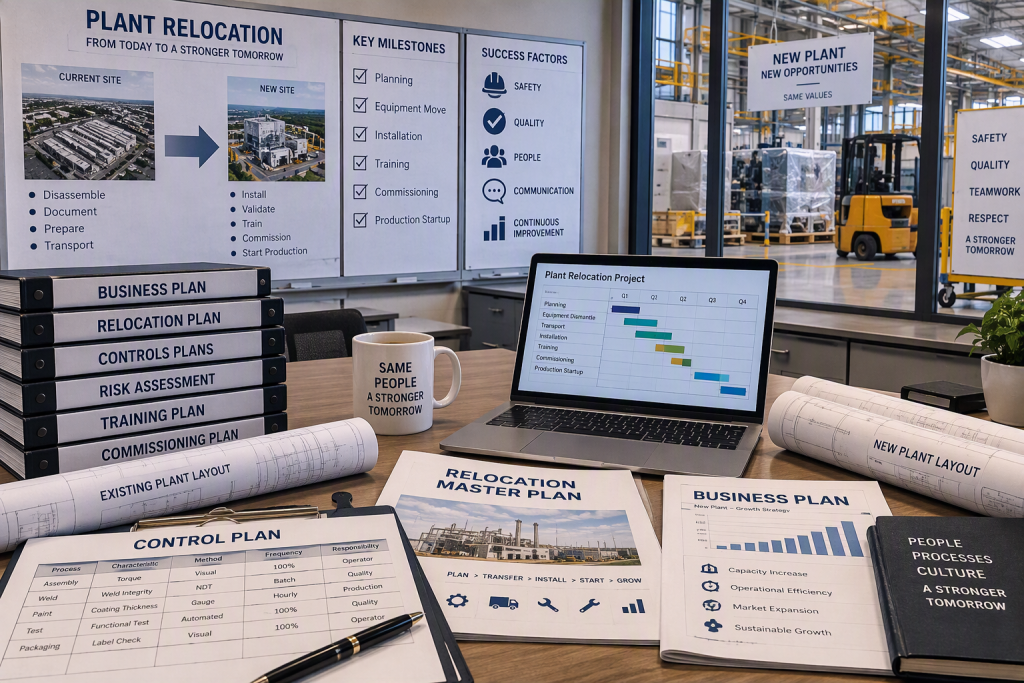
The machinery is transferred. Equipment is installed. Procedures are reviewed. Work instructions are updated. The new facility is prepared to start operating. Everything appears to be progressing according to plan.But there is one asset that cannot be loaded onto a truck and transferred to a new location.
Experience.
For years, experienced employees have learned how the processes actually work. They know which machines require additional attention, which production parameters need careful monitoring, where problems usually occur and how to react when something unexpected happens.
Some of this knowledge is documented in procedures. Much of it is not. It exists in experience, practical judgment and the small details people learn after working with the same processes for years.
The Knowledge That Isn’t Written Down
Many organizations invest heavily in documentation during a relocation.
Standard operating procedures are updated.
Process maps are reviewed.
Training materials are prepared.
Control plans are transferred.
All of these activities are necessary. But they also have limitations. An SOP can explain how a process should work. It can describe responsibilities, parameters, controls and expected results. What it cannot fully capture is every situation that experienced employees have learned to navigate over years of practical exposure.
Why does a machine occasionally behave differently under certain environmental conditions?
Why does one production line require closer monitoring than another?
Also why does a particular issue tend to appear after maintenance activities?
Which warning signs should trigger immediate action even before measurements indicate a problem?
These are often things people know without necessarily realizing how much they know. And that creates a significant challenge. Because transferring responsibility is relatively easy.
Transferring judgment, intuition and problem-solving capability is much harder.
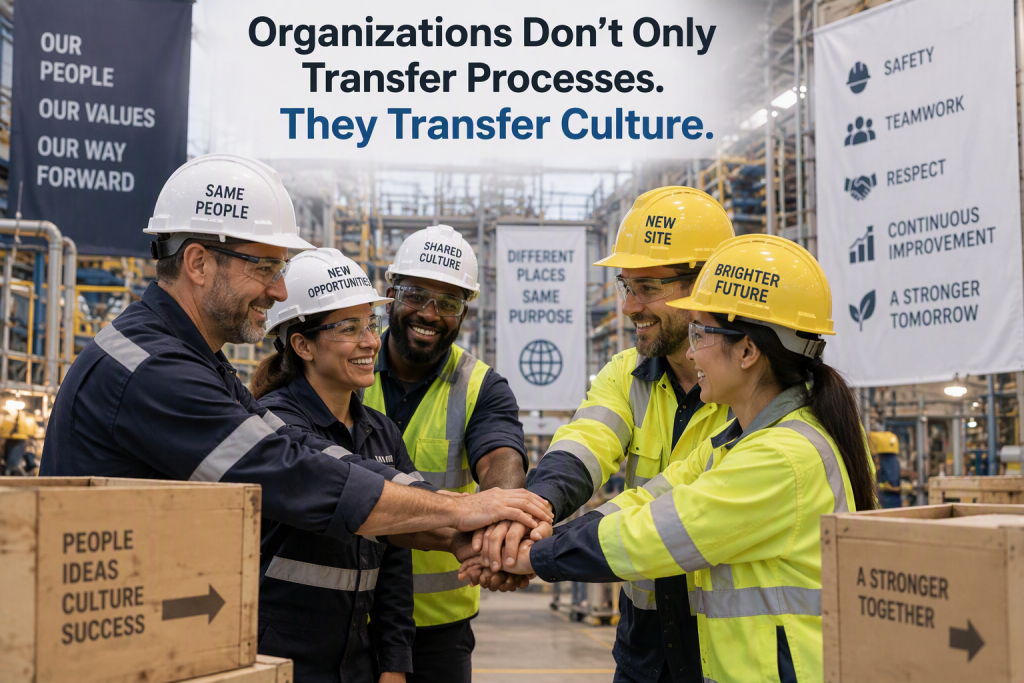
Organizations Don’t Only Transfer Processes.
They Transfer Culture.
There is another aspect of operational capability that is often overlooked during major transformations. When operations move, organizations are not simply transferring technical knowledge. They are also transferring culture.
Experienced employees understand more than process steps and work instructions. They understand why certain standards exist, which issues deserve immediate escalation, how decisions are made when priorities conflict and what level of quality is truly expected by the customer. Much of this is never formally documented.
Two facilities can operate with identical equipment, identical procedures and identical production targets and still achieve very different results. One team may proactively identify risks, challenge recurring issues and continuously look for improvement opportunities. Another may simply follow procedures exactly as written while missing opportunities to improve performance.
Neither approach develops overnight. Just like technical capability, operational culture must be transferred, developed and reinforced over time. The goal of a transformation should not simply be to replicate processes. It should be to replicate the mindset and behaviours that made those processes successful in the first place.
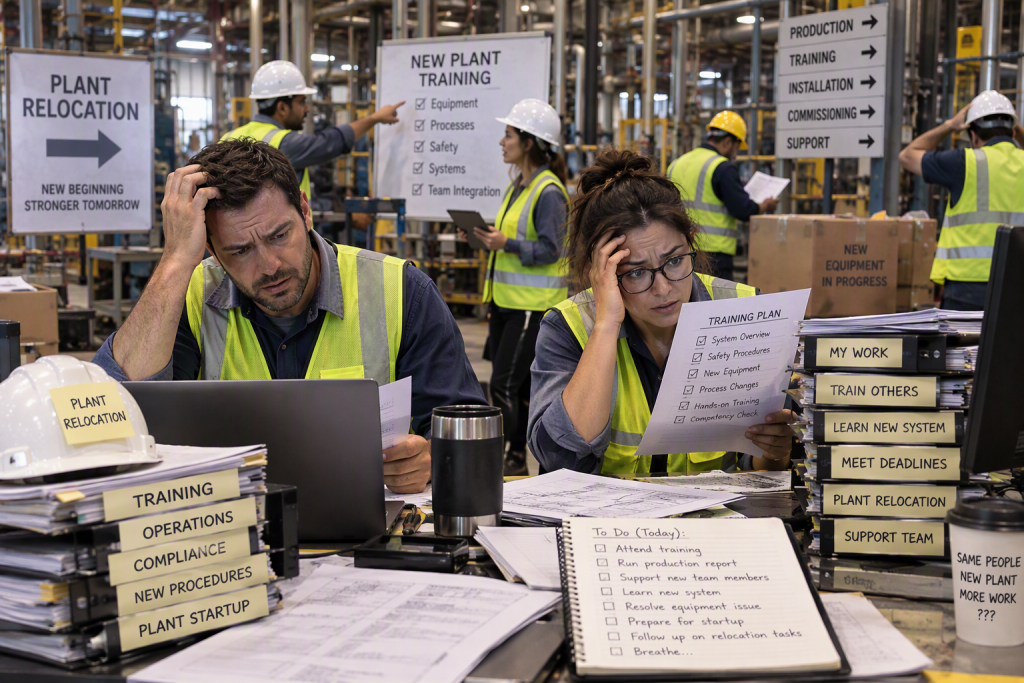
Now imagine starting operations in the new facility. The equipment is installed, but the team is different. Some experienced employees have not relocated. Others have left the company. New employees are still learning the processes. Training is ongoing, production targets are approaching and the organization is expected to reach the same operational standards as before.
The procedures exist, but the practical knowledge behind them is limited. The new team follows the SOPs, but doesn’t necessarily understand all the reasons behind them. Problems that experienced people would have recognized immediately now require investigation. Decisions take longer. Quality issues emerge.
The few experienced people who remain become stretched across several responsibilities. They are expected to train new employees, solve technical problems, support production and maintain the required standards, often simultaneously. The organization is effectively trying to build a new operation while keeping it running.
And this is where the original business case starts meeting operational reality.
The Hidden Cost of Starting From Experience You No Longer Have
When companies calculate the cost of relocation, they naturally consider machinery, transportation, infrastructure, installation, staffing and other direct expenses. But there are additional costs that may be harder to predict.
Part of the challenge is that most relocation projects are built around assumptions.
Training plans are developed. Staffing targets are established. Productivity recovery timelines are created. Operational readiness milestones are defined.
These assumptions are necessary. However, reality rarely develops exactly according to plan.
Employees may require more time to develop competence than expected. Staff turnover may be higher than forecast. Technical issues may occur more frequently. Production performance may recover more slowly than anticipated.
The project itself may be completed successfully while the operation still requires significant support to consistently achieve the expected results. This does not necessarily mean the original business decision was wrong. It simply means that rebuilding operational capability almost always takes longer than rebuilding infrastructure.
Sometimes companies underestimate how difficult it can be to recruit and retain experienced people in a new location. The operation may start with fewer employees than planned. New recruits may have limited experience. Training takes longer, while production targets remain unchanged.
Organizations also frequently focus on replacing operators and production personnel while underestimating how difficult it can be to rebuild leadership capability. Supervisors, team leaders, quality specialists, process engineers and technical experts often carry a significant portion of an organization’s operational knowledge and decision-making capability. These individuals understand how to prioritize competing demands, guide less experienced employees, solve complex problems and maintain operational stability when challenges arise.
Machinery can be purchased and procedures can be transferred. Leadership capability often takes years to develop. A company may successfully recruit enough people to operate production and still struggle because it has not yet rebuilt the leadership and technical expertise required to support the operation sustainably.
Production may take longer to stabilize. Employees need more training than initially expected. Supervisors spend additional time supporting new teams. Quality departments investigate problems that were previously avoided through experience. There may be more rework, additional inspections, production delays and temporary dependence on external specialists or employees from the original facility.
Even the transfer of knowledge can become an expensive exercise if it hasn’t been properly planned. Imagine expecting a small group of experienced employees to train an entire new workforce while simultaneously supporting daily production. The training becomes fragmented, important details are missed and the people responsible for transferring knowledge have little time to do it properly. This creates competing priorities.
Do we focus on training or production?
Did we stop the process to investigate a recurring problem or keep running to meet the delivery schedule?
Do we spend time improving a process or concentrate on getting through the current workload?
An SOP Cannot Replace Years of Experience
The organization starts depending on a small number of experienced employees to compensate for gaps in staffing, knowledge and operational readiness. But this is not a sustainable solution. You cannot build a stable operation indefinitely on the additional effort of a few individuals.
At the same time, organizations should be careful not to rely excessively on undocumented expertise. If critical operational knowledge exists only in the minds of a few individuals, the organization already faces a significant risk.
Retirements happen.
Career changes happen.
Relocations happen.
Unexpected absences happen.
Strong organizations understand that procedures and experience are not competing concepts. They complement one another.
Procedures create consistency. Training develops competence. Experience builds judgment.
The objective should not be to choose between documentation and expertise, but to ensure that critical knowledge can survive and be developed beyond any individual employee.
The organization may have successfully moved its equipment, but it hasn’t necessarily transferred the capability to operate it efficiently.
And this distinction matters.
Moving an operation is a project. Rebuilding its operational capability is a much bigger undertaking.
The Cost of Doing Just Enough
This is where the human side connects directly to business performance. When employees are overwhelmed, insufficiently trained or disengaged, they may eventually concentrate on fulfilling their immediate responsibilities. There is a full article on the blog related to this topic, which you can find right here: Corporate Survival: When Doing a Good Job Becomes a Disadvantage.
They complete the assigned tasks. They follow the instructions. And they deliver what is requested. But they may have little capacity or motivation left to do anything beyond that.
An experienced employee who previously identified process improvements may now focus exclusively on production requirements. A new employee who encounters a recurring problem may simply follow the existing instructions because they don’t yet have the experience to challenge the process. A supervisor who spends most of the day solving immediate operational problems has little time left to develop the team.
The organization continues functioning, but its ability to improve becomes limited. And this can have consequences far beyond the initial relocation.
The company may find itself spending more time correcting problems, more resources supervising processes and more money trying to achieve the productivity levels that were originally expected. The cost isn’t necessarily visible in one particular department or financial report. It is distributed across the operation.
This is why the contribution of employees should not be evaluated only through the tasks they complete. Their experience, problem-solving ability, initiative and knowledge-sharing also create business value. When these capabilities are not developed or properly used, the organization loses an important part of its operational potential.
When Should We Consider a Transformation Successful?
I think companies should be careful about how they define success in major operational changes.
A factory can be relocated. Production can restart. Equipment can be operational. The new facility can meet its initial targets. But is the transformation really successful if, six months later, quality problems are recurring, experienced employees are exhausted, productivity remains below expectations and the new team still depends heavily on external support?
Perhaps the relocation was completed on time, but the operation is not yet stable. Perhaps the financial benefits are still achievable, but the organization has underestimated the resources required to reach them.
And perhaps the most important part of the transformation, developing a capable and independent team, is still unfinished. These are things that cannot always be captured by a project completion date or an initial financial report.
Companies should also evaluate:
- How long does it take for the new operation to reach stable production?
- Are quality and delivery performance improving as expected?
- Has critical operational knowledge been successfully transferred?
- Can the new workforce operate independently, or does it still rely heavily on a few experienced individuals?
- Are staffing levels and training resources sufficient?
- Are recurring problems being eliminated, or simply managed?
- Are the expected financial benefits being achieved after accounting for the real transition costs?
These questions provide a more complete picture of whether a transformation is delivering what it promised. Because completing a transformation and making it sustainable are two different achievements.
Perhaps the most important distinction is this:
Completing a transfer and rebuilding operational capability are not the same achievement.
A project can be delivered on schedule. Equipment can be installed. Production can restart. But true success is only achieved when the operation can consistently deliver results without depending on extraordinary effort, constant support or a small group of experienced individuals carrying the organization forward.
What Could Companies Do Differently?
I don’t think the answer is to avoid difficult decisions or to assume that every operational change can happen without disruption. Change will always involve challenges, and businesses need to remain adaptable. But there are several things that can make the difference between a relocation that simply reaches its implementation deadline and one that creates a genuinely successful operation.
1. Treat knowledge transfer as a project priority.
Identify the critical knowledge held by experienced employees before the transition begins. Don’t assume that procedures contain everything the new team needs to know.
2. Plan for a realistic transition period.
A new facility may be ready to start production, but that doesn’t mean the workforce is ready to deliver at full capacity. Training, supervision and operational stabilization require time.
3. Protect the people responsible for transferring experience.
Don’t expect a handful of experienced employees to train an entire workforce while carrying their normal responsibilities without additional support.
4. Involve operational teams in strategic planning.
The people who understand the daily processes can identify practical risks that may not be visible in financial projections. Their input should be part of the decision-making process, not something requested only when implementation begins.
5. Measure sustainable performance, not just implementation deadlines.
A project shouldn’t be considered successful simply because equipment has been installed or production has restarted. The organization needs to demonstrate that the new operation can deliver consistent results with a capable and sufficiently resourced workforce.
6. Transfer culture and leadership, not only processes.
Organizations should actively transfer expectations, problem-solving approaches and leadership practices alongside technical knowledge. Sustainable performance depends not only on what employees do, but also on how they think, collaborate and respond when challenges arise.
To sum it up we can relocate operations, transfer responsibilities and redesign processes. We can move equipment, update procedures and build new facilities. But sustainable performance depends on something much harder to relocate: knowledge, experience, leadership and operational culture.
The companies that succeed in transformation are not necessarily those that move the fastest or spend the least. They are the ones that understand that operational excellence is built through people as much as through assets. Because ultimately, the goal is not simply to move an operation. The goal is to recreate the conditions that allowed that operation to succeed in the first place. And if those conditions are overlooked, an organization may discover that while it successfully moved the business, it left behind a significant part of its ability to perform.
A step by step guides for relocation guidecan be found at the KAizen institute web page: here
Leave a Reply